
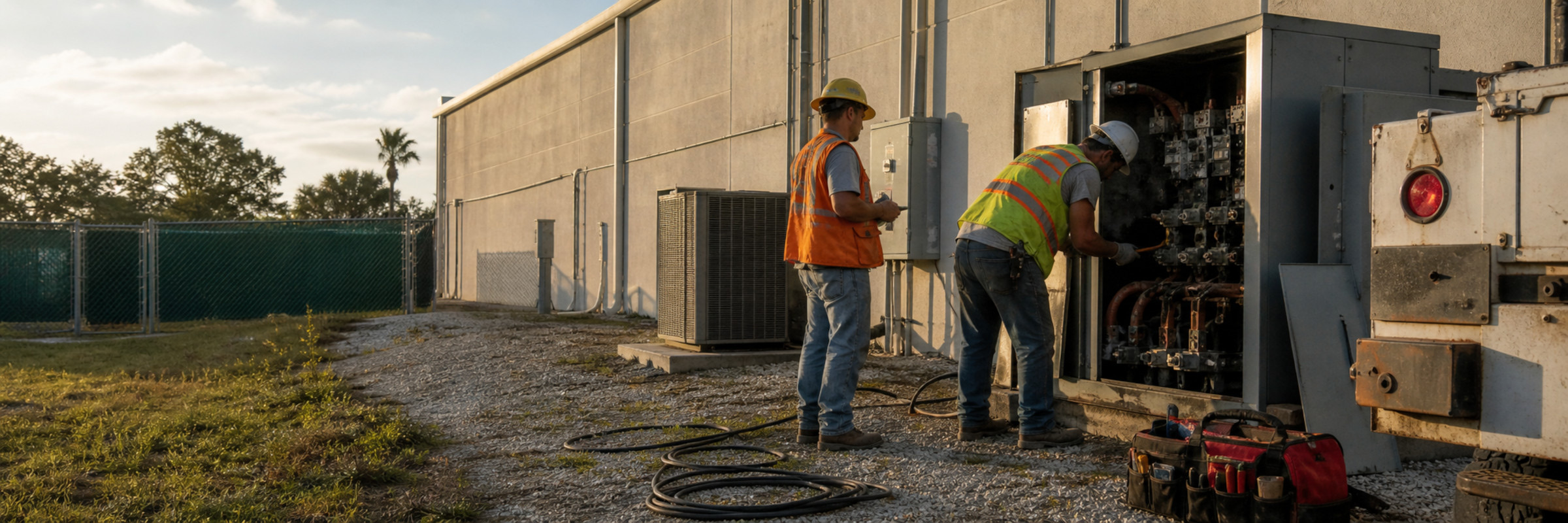
An internet outage tied to a facility in West Palm Beach disrupted service across parts of South Florida this week, including communities well outside the immediate area.
According to preliminary updates, the issue began with a loss of power at the site. Technicians later identified an electrical short as the root cause, which led to a broader network failure before service could be isolated and restored.
For customers in Hendry County and surrounding areas, the result was familiar: slow connections, dropped service, and a stretch of time with little clarity on what was actually happening.
A localized issue with a wide footprint
Incidents like this tend to follow the same pattern. The problem itself is contained to a single facility or segment of infrastructure, but the impact travels much farther.
Large internet providers rely on centralized systems that route traffic through major hubs. When one of those hubs goes offline, even briefly, the disruption isn’t limited to the immediate area. It affects every location tied into that path.
That’s why an issue in West Palm Beach can show up as a service interruption in LaBelle or Clewiston.
Why outages like this aren’t unusual
Power failures, fiber cuts, and equipment issues are all part of maintaining large-scale networks. None of these are especially rare on their own.
What makes them noticeable is how much depends on a relatively small number of critical points. When one of those points fails, there isn’t always a secondary path ready to absorb the traffic.
In more densely built networks, particularly in urban areas, redundancy is often built in through multiple routing options. In rural regions, the infrastructure has historically been extended to reach customers rather than designed around them.
That difference shows up during outages especially.
The customer experience
From the outside, the cause of an outage isn’t always obvious. Most people encounter it the same way: a connection that slows down or drops entirely, followed by a period of waiting for updates or restoration.
There’s often little a customer can do in the moment. The issue exists beyond the home network, somewhere upstream in the provider’s system.
That gap between the cause and the experience is part of what makes these incidents so frustrating. The explanation arrives later, sometimes long after service is already disrupted. It’s the same dynamic that drives steady price creep on big-provider plans — decisions made far away that quietly land on your bill or your evening.
We take a different (more local) approach to network design
Not all networks rely on a single path or centralized hub in the same way.
Some providers, particularly those building infrastructure at a local level, use multiple data routes to reduce the impact of a single failure. In those cases, traffic can be rerouted automatically if one connection goes down.
Streamline Internet, which operates in Hendry County and Golden Gate Estates, is one example of that approach. Our towers are connected through multiple independent feeds — including both wireless and ground-based fiber — with battery backup in place so you never feel an outage. Certain sites even use generators to maintain service during extended power outages.
We can’t eliminate outages entirely. But our “backups for the backups” approach limits how far they can spread and how long they last.
If you run a business, the same thinking applies inside your own building. A second connection on a different path means an upstream failure like this one costs you a hiccup instead of a day. We put numbers on that in our guide to backup internet connections for business, including a calculator that works out what an outage costs your operation.
Built for here, not extended out to here
There’s a meaningful difference between a network extended to a place and a network designed for it.
Most regional internet infrastructure in rural Florida started somewhere else. A big provider’s footprint grew outward year by year — fiber strung along a state road, a hub in a city handling traffic for a county fifty miles away, engineering decisions made in a boardroom in another state. When something breaks, it breaks the way a stretched-thin system breaks: far away, all at once, and not because of anything the local team did.

We engineered this network to be hyperlocal — built for exactly this market, not extended out to it. The redundancy is actually here when something fails upstream because we designed the whole thing around this footprint, not bolted it onto someone else’s.
Streamline was engineered the other direction. Every tower, every backhaul path, every battery and every generator was specced with this exact footprint in mind — Hendry, Glades, Golden Gate Estates, the parts of Florida the big providers were never going to design around. The redundancy isn’t bolted on after the fact. It’s how the network was built from day one.
No engineering firm in another state was ever asked, “what would actually keep service up in LaBelle when a power blip in West Palm Beach takes down a hub?” That question is the one our network was built to answer.
Tired of being downstream of someone else's outage?
See if Streamline covers your address. Most homes are connected within a week.
Check availabilityLocal factors that change the equation
Ownership and proximity also play a role in how issues are handled.
Streamline is based in Southwest Florida, with technicians who work within the service area. That has a direct impact on response times and communication, especially compared to larger providers operating across multiple states or regions.
Our network is also tied into local infrastructure through county partnerships, including support for public safety communications. That kind of integration tends to raise the standard for reliability, particularly during emergencies.
What this outage reflects
The West Palm Beach incident is one example of a broader pattern in how internet service is delivered across rural parts of the state.
When infrastructure is centralized, a single point of failure can affect a wide area. When it’s distributed and built with redundancy in mind, the impact of those failures can be reduced.
Are outages a norm for you?
If your connection drops every time something happens somewhere else, it’s worth checking what your internet is actually built on — and whether there’s an option that’s designed for the way this area operates. Streamline covers much of Hendry County and Golden Gate Estates, with plans starting around $55/month.
Check what's available at your address.
Coverage checks take less than a minute. Most homes are connected within a week.
Check availability