

You can like your internet provider and still lose a Friday to them.
Out here the weather, the dirt, the power grid, and a guy with a rented skid steer are all part of your network whether you planned for them or not. No single provider fixes that. Two of them do.
Before anything else, find out what a day like that is worth to you. Put your numbers in and keep the total in view while you read.
Everything down here is trying to take your internet out
Kleetus, Leroy, and the shovel
Somewhere in your county right now, two guys are setting a fence post or chasing a broken sprinkler line. What they are not doing is calling 811.
Sunshine 811 is free and Florida law asks for two business days’ notice. Somebody comes out and sprays orange marks over the buried fiber so you know where not to dig. Plenty of people skip it, and one scoop of dirt later the street is down while a splice crew drives in from wherever splice crews live.
Florida recorded 29,207 damages to buried utilities in 2024, up 8.6% on the year before. Telecom was 88% of them. In three out of four cases, nobody filed an 811 ticket.
No provider engineers around that. Nobody has figured out how to harden dirt.
Hurricane season, which is half the year
June 1 through November 30. Poles come down, aerial fiber comes down with them, and cabinets that were never meant to sit in water end up sitting in water. Your building can come through a storm fine and still have nothing to connect to, because the damage is a mile up the road.
Ian gets talked about more, but Irma is Hendry County’s storm. Its eye passed fifteen miles west of LaBelle on September 10, 2017, the statistical peak of the season, putting the county on the strong side of the track.
Two days later, FCC filings show 78% of Hendry County’s cell sites out of service, still above 10% out eight days on. Every one of Hendry’s 18,750 electric accounts lost power, the only county in Florida to hit 100%. During Ian, the average LCEC customer went 9.2 days without power.
Hendry has been under a federal disaster declaration for a tropical cyclone in seven of the twenty-one seasons between 2004 and 2024. The last two were quiet, which is exactly when this stops feeling urgent.
Our towers are built for it, with backup connections, battery backup, and generators at some sites. That still doesn’t make any one connection a plan, ours included.
The power going out
Your internet needs power along the whole path, not only inside your building. A UPS under the counter keeps your register lit while the neighborhood node sits dark.
In 2024 the average Florida customer went 24.8 hours without power, against 11.0 nationally, and FPL attributed 92% of its interruption minutes to named storms. Florida also leads the country in lightning density.
The local grid is thin before any of that. FPL’s Clewiston circuits run 93% overhead at 14 customers per mile and delivered 3.9 times the FPL system average in outage minutes in 2025. Rural circuits are long, exposed, and rarely first in line.
Brush fire season
Peak wildfire season is April through June, though 2026 started early: in February the West Boundary Road Fire burned 2,624 acres in southern Hendry County and smoke shut 57 miles of I-75 overnight.
Fires cause two problems at once, burned poles and roads nobody is allowed down, so a four-hour repair becomes a two-day one.
The stuff that has nothing to do with Florida
Upstream equipment fails. A hub in another city loses power and takes service down across the region. Maintenance runs long, a truck clips a pole, a router you’ve never heard of reboots badly. That’s what happens when you run physical infrastructure across a lot of miles.
What an outage costs you
Most owners have a number in their head, and it’s usually low, because only part of the damage is visible while it’s happening.
Revenue you don’t collect. No internet, no card processing. A “CASH ONLY, SORRY!” sign on the register on a Friday night costs more than the guess.
Payroll you pay anyway. Staff still on the clock while scheduling, EHR, dispatch, QuickBooks, inventory, online ordering and the field tablets all sit there.
Customers who can’t reach you. VoIP phones go down with the internet, so every call in that window rings into nothing. They call the next place on the list and you never find out.
Reviews you can’t undo. “Drove 20 minutes, they couldn’t take my card.” You’ll make the revenue back next week. The review stays up for years.
The first two you can put a number on, which is what the calculator does. The last two are real money that never shows up anywhere you can add it.
Two internet connections, one gateway
Two circuits from two different providers feed one gateway that decides which to use. If the primary drops, the backup picks up automatically. Nobody unplugs anything.
Two circuits from the same provider usually won’t do it. They tend to ride the same conduit and terminate at the same upstream hub, so one backhoe takes out both and you’ve paid twice for one connection. You want different technology on a different physical route.
That’s why fixed wireless pairs well with a wired connection. The path to our tower doesn’t share a trench with the fiber down the block, so a backhoe can’t cut it. If something goes wrong at the tower, the fiber under the road doesn’t care.
Either can be primary. What we see most often:
- Streamline primary, cable or DSL as backup. When the existing wired service is slow but cheap enough to keep.
- Existing fiber primary, Streamline as backup. Good fiber is worth keeping. Streamline becomes the connection that stays up when it gets cut.
- Either, plus cellular underneath. For sites where even minutes of hard down is a problem.
If you can only afford one connection
Plenty of businesses here can’t carry two circuits. If you’re having one, have the one built to stay up.
Our network was engineered for this county rather than extended out to it. Every tower runs on backup connections, so an upstream cut doesn’t take the site with it. Every tower has battery backup and some sites have generators, which is the difference between a network that dies with the grid and one that doesn’t. That’s where the 99.9% uptime target comes from.
The other half is who shows up. Our technicians live in Southwest Florida. When something breaks, the person fixing it drives over from LaBelle instead of routing your ticket out of state and offering you Thursday. In the storms above, that difference is measured in days.
If being offline isn’t survivable for you, Dedicated Internet Access is a private circuit with unshared symmetric bandwidth and a full SLA, so the uptime commitment is contractual rather than a target.
Two connections is still the stronger answer. But if the budget reaches one, put it on the network designed around what takes the others down.
How failover actually works
The gateway sits between your business and both connections, health-checking each one continuously. Not just whether the cable is plugged in, but whether it can reach the internet through that path.
When the primary fails those checks, traffic moves to the backup, usually within 5 to 30 seconds. Card readers, cloud apps and browsers recover on their own.
One rough edge: a call already connected when the switch happens may drop and need redialing. After that, calls run over the backup normally. Not seamless, but a 15-second hiccup is a different day than a four-hour shutdown.
When the primary comes back and stays healthy, the gateway moves traffic back on its own.
The hardware: UDM-SE or UXG-Max
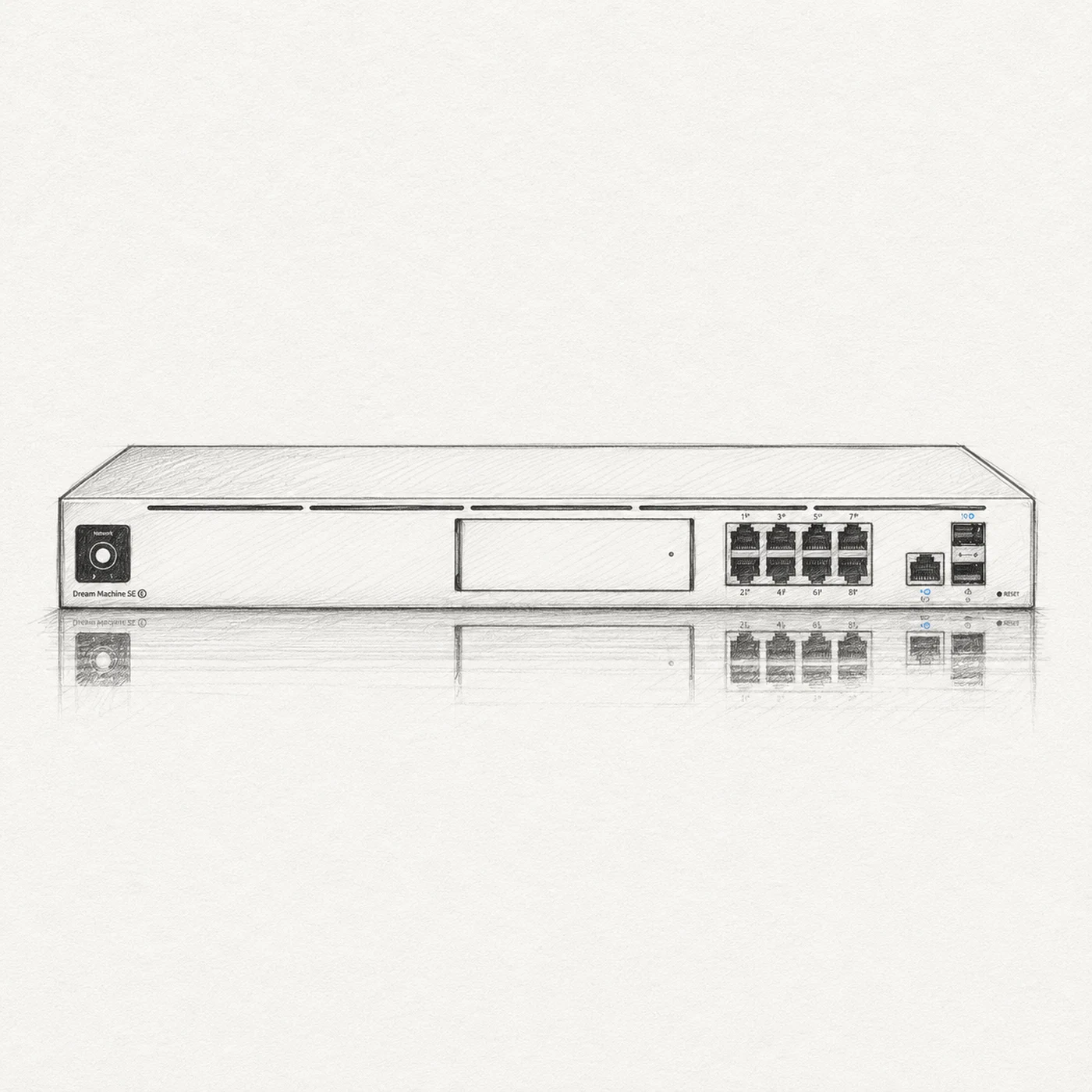
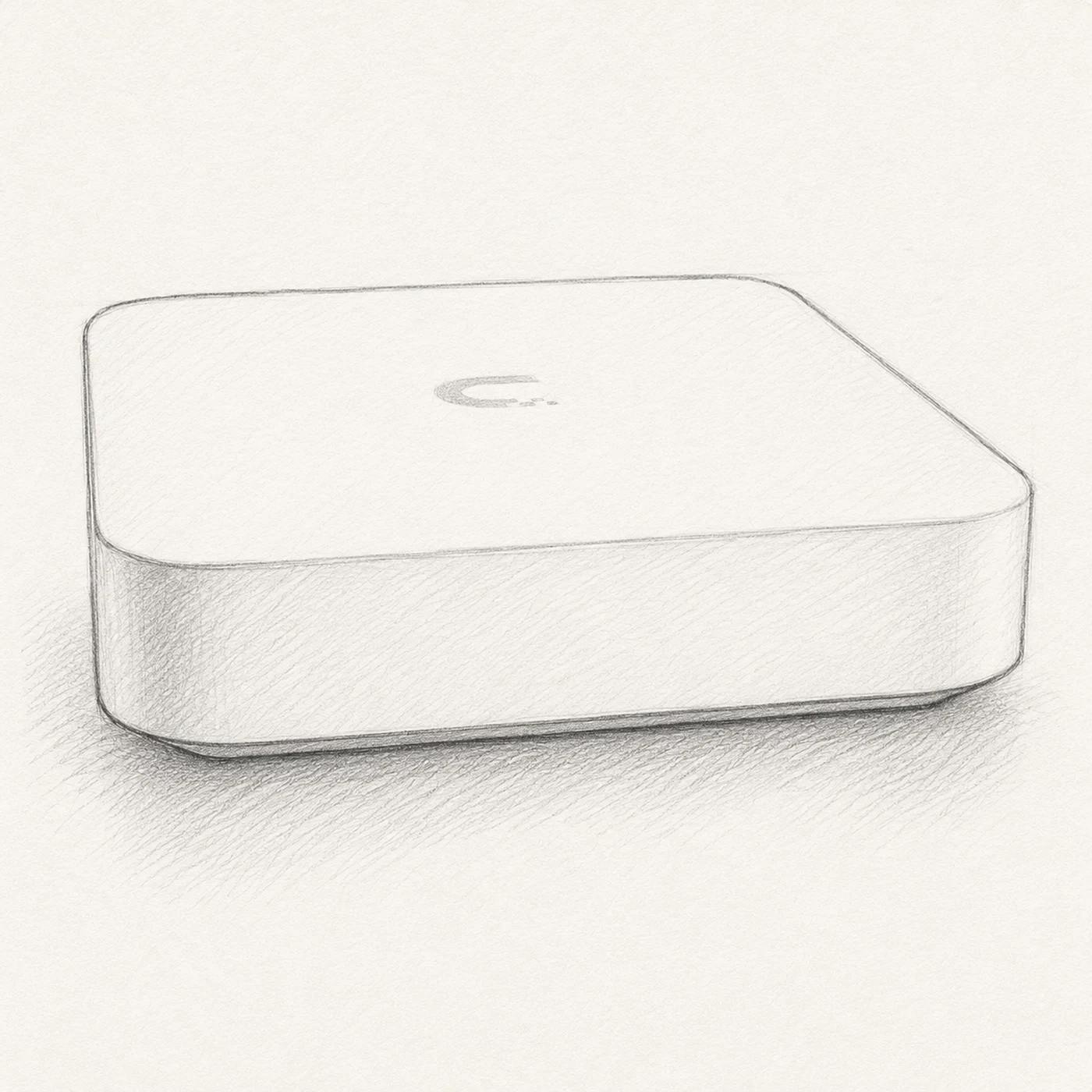
| UDM-SE | UXG-Max | |
|---|---|---|
| Form factor | 1U rackmount | Compact desktop |
| WAN connections | Up to 8 | Up to 4 |
| Ports | 8× GbE PoE, 1× 2.5 GbE, 2× 10G SFP+ | 5× 2.5 GbE |
| PoE budget | 180W, powers cameras and access points | None |
| Threat protection | 3.5 Gbps | 2.3 Gbps |
| Camera recording | Built-in NVR, 128 GB SSD + HDD bay | Not built in |
| Cellular backup | Supported | Supported |
| Best for | Offices and clinics with a rack, cameras, several access points | Shops, restaurants, single-suite offices |
Both watch two connections and keep the working one in service. Pick the UDM-SE if you have a rack and PoE devices, since it powers your cameras and access points off the same box. The UXG-Max is for everywhere else and is no less capable at failover.
Our engineers set it up during install
Failover gets configured by our network engineers while we install your Streamline Business circuit. Not a separate project, and no third-party consultant billing hourly to learn your building.
During the install we:
- Mount and configure the gateway, then cut your network over to it
- Bring in the second connection and set WAN priority
- Tune the health checks so failover triggers on a real outage, not a two-second blip
- Set which systems fail over and which stay pinned to the better path
- Test it. We pull the primary while standing there and watch your POS and phones keep running

The part customers remember is when I unplug the main line at the end of the install. The phones keep ringing, the card reader still works, and you can watch them decide it’s going to hold.
After that, priority support is a phone call to people who live here and have your configuration in front of them.
Is it worth it?
Hold the calculator’s number next to the price of a second circuit, which starts at $99.99 a month on Business Essential. For most businesses in Hendry County and Golden Gate Estates, one bad afternoon covers most of the year.
That comparison is generous to the outage, too. The calculator only counts what you can put a number on. The customers who called somewhere else and the review still up in three years never make it into the math.
Two connections, one less thing to worry about.
Check coverage for your business address, or call and we'll walk through what redundancy would look like at your site.
Check availabilityWant to talk it through first? Contact our business team →
Where these numbers come from
Every figure in the calculator is federal data for this county or, where none exists, our own estimate labelled as one. The slider defaults to four hours as a middling guess: rural providers report a median restoration of 75 to 90 minutes for an ordinary fault, while a storm is counted in days. Full working below, including the numbers we chose not to use.
Sources and assumptions 37 citations, and what we could not source
We built the calculator out of federal data for this county rather than the downtime statistics that circulate in ISP marketing. Here is every number behind it, where it came from, and which parts are our estimate rather than someone’s published figure.
The formula
That is the whole model. There is no reputation multiplier, no churn factor, and no lost-customer-lifetime-value adjustment, because those are the components every vendor calculator inflates and none of them can be defended with a source.
Revenue per open hour
Receipts per establishment come from the 2022 Economic Census, the most recent vintage available. Receipts publish only in years ending in 2 and 7, so the next update is the 2027 Economic Census around 2029.
Where the Census suppresses a Hendry County cell for disclosure reasons, we fell back to the Clewiston Micro Area (CBSA 17500, which is Hendry plus Glades counties) or to a five-county rural aggregate of Hendry, Glades, Highlands, DeSoto and Okeechobee. Four of the nine presets are Hendry County proper. None of them fall back to a national average.
| Preset | Per hour | Receipts per establishment | Geography | Annual operating hours |
|---|---|---|---|---|
| Restaurant or cafe | $270 | $1,160,532 | Hendry County | 4,264, derived from Datassential |
| Retail shop | $325 | $895,238 | Five-county rural aggregate | 2,754, our estimate |
| Convenience store or gas | $465 | $2,718,391 | Clewiston Micro Area | 5,840, our estimate |
| Medical or dental office | $450 | $850,500 | Hendry County and Clewiston Micro Area | 1,884, part sourced |
| Professional office | $240 | $477,162 | Hendry County | 2,000, our estimate |
| Auto repair shop | $260 | $601,035 | Five-county rural aggregate | 2,295, our estimate |
| Salon or barbershop | $65 | $171,000 | Hendry County | 2,700, our estimate |
| Farm or ranch, smaller | $35 | $83,338 | Hendry County (USDA) | 2,500, our estimate |
| Commercial farm or packhouse | $3,200 | $8.08M and $7,884,855 | Hendry County and Florida | 2,500, our estimate |
The soft spot is operating hours. No US government source publishes how many hours a business is open, for any industry. We checked. Restaurant hours are derived from two published Datassential figures rather than a published total, and the dental half of the medical preset uses the American Dental Association’s 36.1 hours per week. Every other hours figure in that table is our own assumption, which is why we show it. If your shop keeps different hours, change the revenue number.
Three notes on individual rows. Salon is the weakest preset, built on six establishments, and the Economic Census counts employer businesses only, so booth renters running their own card terminals are not in it. Agriculture is split in two because a single average would be wrong for everyone: 19% of Hendry farms produce 95.8% of the county’s agricultural sales. Packhouse receipts are Florida statewide, because the Census publishes no sub-state geography for that sector.
Two independent checks came back clean. NACS convenience store sales per store for 2025 land within 0.4% of the Census figure, and the ADA’s median revenue per rural general dentist sits at a ratio of 1.12 to the Census per-establishment number, which is what you would expect when a practice has more than one dentist.
Wages
Wages are May 2025 BLS Occupational Employment and Wage Statistics, weighted by the actual staffing pattern of each industry rather than picking one job title. Hendry County falls in the South Florida nonmetropolitan area; Golden Gate Estates falls in the Naples-Marco Island MSA. Each preset is the midpoint of the two areas, moved to 2026 using the Employment Cost Index.
| Preset | Average hourly wage |
|---|---|
| Restaurant or cafe | $17.50 |
| Retail shop | $23.00 |
| Convenience store or gas | $20.25 |
| Medical or dental office | $33.00 |
| Professional office | $37.00 |
| Auto repair shop | $27.75 |
| Salon or barbershop | $23.00 |
| Farm, ranch or packhouse | $18.00 |
Two things worth knowing. OEWS wage figures include tips, so the restaurant number is not the gross $21.75 an hour that servers earn. Waiters and bartenders are 38% of full-service restaurant staff and their direct cash wage from the employer is Florida’s tipped minimum of $10.98, so the preset reflects what the owner actually pays while people stand around. If an outage runs long enough that tips don’t bring a tipped worker to full minimum for the week, federal law puts the difference back on the employer, and the real figure climbs toward the gross.
We use means rather than medians because the calculator multiplies headcount by wage, and only the mean reconciles to total payroll. Medians in these categories run 8% to 12% lower.
This table goes stale on September 30, 2026, when Florida’s minimum wage steps from $14.00 to $15.00 and the tipped direct wage goes from $10.98 to $11.98. The restaurant, convenience store and agriculture presets will move.
What the calculator does not count
It counts two things you can put a number on. It leaves out the calls that rang into nothing, the customers who drove to the next town, and the review that stays up afterward. That makes the total conservative on purpose.
On reviews there is real research, though it is narrower than the way it usually gets quoted. Michael Luca of Harvard Business School matched Yelp ratings to Washington State tax records for Seattle restaurants and found that a one-star increase in rating led to a 5% to 9% increase in revenue, an effect that showed up only at independent restaurants and not at chains. That is a working paper rather than a peer-reviewed article, it covers restaurants in one city between 2003 and 2009, and we would rather say so than round it off. The peer-reviewed companion study by Anderson and Magruder found that an extra half star made Bay Area restaurants sell out 19 percentage points more often.
The numbers we chose not to use
You will see much bigger figures on other pages selling backup internet. The common ones are worth naming, because we went looking for their sources and mostly could not find them.
“Downtime costs $5,600 per minute” comes from a 2014 Gartner blog post that published no methodology, no sample and no data, and that Gartner has since deleted from its own website. “$300,000 an hour” is either that same number multiplied by 60 or a figure that its publisher explicitly limited to midsize and large enterprises. The widely quoted claim that Ponemon found downtime costing small businesses $137 to $427 per minute does not appear anywhere in the Ponemon report; that study looked at 63 data centers, and neither number is in it. “40% of small businesses never reopen after a disaster” has been attributed to FEMA for years and researchers have repeatedly failed to find any FEMA study behind it.
For scale, the Uptime Institute’s 2024 outage analysis found that among professional data center operators, roughly 46% of significant outages cost less than $100,000. The six-figure-per-hour numbers describe large enterprises. They were never about a restaurant in LaBelle, and quoting them at you would be a good way to get everything else on this page ignored.
Share of sales that need the connection
This is the weakest column in the calculator and we would rather say so than pretend otherwise.
The solid part comes from the Federal Reserve’s 2024 Survey and Diary of Consumer Payment Choice. Restricted to purchases, cash is 16.8% of transactions but only 7.6% of dollars, because five out of six cash payments are for amounts under $25. Since the calculator works in revenue rather than transaction counts, the dollar figure is the right one, and using the count would have understated exposure by roughly half. That gives retail a well-grounded 90%. Convenience stores sit at 82% on NACS industry figures, with pay-at-pump effectively all card.
Restaurants are at 90% for a reason that is only partly about payments. Roughly three quarters of restaurant traffic is now off-premises, and delivery and online orders don’t wait out an outage, they go to a competitor. We looked for the widely quoted “85% of restaurant tabs are paid by card” figure, could not trace it to an original source, and left it out.
Four categories have no primary payment data at all. Medical, auto repair, salons and professional offices are reasoned estimates, not measurements, and they are editable for that reason. Medical is set at 60% because most practice revenue is insurance reimbursement arriving days later by ACH, so an outage mostly delays money rather than destroying it, while what actually stops work is the cloud scheduling and records system. Salons carry the widest genuine spread, somewhere between 55% and 85%, because a booth-rent barbershop and a chain salon on cloud booking are different businesses.
Professional offices are the biggest correction we made. An earlier draft had them at 90%, which was simply the wrong model. Law and accounting firms bill after the fact: Clio’s benchmarks put the median firm at 93 days between doing the work and banking the cash, with only 38% of the day billable to start with. There is no payment in flight for an outage to intercept. The preset is now 25%, reflecting billable hours lost rather than sales missed, and the portion of that we assume never gets made up is our judgment rather than a published figure.
Farms and packhouses have no preset at all. These are invoice-terms businesses selling to distributors, so the payment model doesn’t fit, and the real exposure runs through scales, grading, traceability records and load scheduling instead. During harvest with perishable product in the building an outage can cost nearly everything; out of season it can cost almost nothing. Any single number would be a guess wearing a suit, so that field starts empty.
We also dropped a Worldpay figure that corroborated the retail number, because the edition we wanted is gated, superseded, and absent from the Internet Archive. We could not open the primary document, so it isn’t here.
If your card terminal has offline mode
Square, Toast, Clover and Stripe Terminal all support store-and-forward card payments, which means a properly configured terminal can keep taking cards while the internet is down. Worth knowing, and worth knowing what it costs you.
All four shift the entire risk to the merchant. Square’s own words: “You’re responsible for any expired, declined, or disputed payments accepted while taking offline payments.” Stripe is blunter still, warning that if the issuer declines, “there’s no way to recover the funds, and you might not receive payment from the customer for goods or services already provided.” Square holds offline payments for 72 hours and anything not forwarded in that window is gone. Visa’s rules require authorization within 24 hours of the transaction for most merchant categories, which sits awkwardly against Clover’s seven-day default.
The exclusions matter too. Square’s offline mode does not cover Tap to Pay on iPhone or Android, gift cards, Cash App Pay, or Afterpay. Stripe bans swipe entirely. And none of it touches online ordering, delivery apps, or cloud booking, which is where a good share of the loss in this calculator actually sits.
Cellular failover is thinner than most people assume. Square Terminal has no cellular radio at all. Toast’s fixed terminals, printers and readers are Ethernet-only, with cellular on the handheld alone. Stripe ships cellular disabled by default and bills it monthly.
So we did not build an offline-capture discount into the calculator. No vendor publishes offline capture or decline rates and no independent study exists, so any percentage we applied would be invented. If your POS is configured for offline payments in advance, you may still collect a portion of card sales, you carry the risk on every one of them, and you lose the online channels regardless.
One related point of Florida law, since it comes up: there is no statewide cash-acceptance requirement here. We checked Chapter 501 of the Florida Statutes and a national survey of cash-discrimination laws, though not every municipal ordinance.
Outages, storms and the other hazards on this page
Every figure in the sections above comes from a primary source, and a few widely repeated claims got cut because they didn’t hold up.
Buried line damage. Sunshine 811’s 2025 enforcement review, covering calendar year 2024, reports 29,207 unique damages statewide, up 8.6%, with telecom the top facility type at 88% and no 811 ticket present in about three quarters of cases. Nationally the Common Ground Alliance counted 221,717 damage reports in 2025, with telecom at 51%. Those two percentages are computed on different bases and are not the same measurement, which is why we quote the Florida one for Florida. Florida’s two-full-business-day notice requirement is statutory, at section 556.105(1)(a).
Hurricane Ian. Cell site outage percentages and subscriber counts are read from the FCC’s daily Disaster Information Reporting System filings from September and October 2022. Two honest caveats: the FCC notes that cell site counts do not map directly onto customer service loss because coverage overlaps, and the reporting area shrank as counties recovered, so only the county rows are comparable day to day. Power restoration and the 100% member outage figure come from LCEC’s own published accounts.
Power reliability. Florida and national outage duration are from the EIA’s Electric Power Annual 2024, published October 2025, using the IEEE standard including major event days. Excluding major storms, Florida actually outperforms the national average at 1.1 hours against 2.2. That inversion is the whole point: the grid here is fine until it isn’t. The 92% storm attribution is from the Florida Public Service Commission’s November 2025 review of investor-owned utility reliability.
Lightning. Density figures come from Vaisala Xweather’s 2025 annual lightning report, restated by the National Weather Service. We say density rather than total on purpose, because Texas records more strikes overall.
Wildfire. Season timing is quoted from the Florida Forest Service. The Hendry County and Big Cypress fires of February 2026 are from local reporting of Florida Forest Service and National Park Service information and from the Florida Department of Transportation’s own road closure advisory.
Outage duration. The 75 to 90 minute median is from NRTC’s 2024 rural broadband operations benchmarking report, a survey of rural providers. We give it as a range because the report contradicts itself between 75 and 90 minutes in different places. There is no authoritative national figure for how long a business internet outage lasts, and there is no credible published figure for how many outages a business has per year, so the outages-per-year field starts at four, which is a round number rather than a finding, and is yours to change.
Staff on the clock. Census does not publish employees per establishment by industry for a county this size, so the staff defaults are our estimate. We anchored them to the local size distribution, where 55% of Hendry County establishments have fewer than five employees and 78% have fewer than ten. If you run a bigger crew than the preset, change it.
Which storm was worse here. It is easy to assume Ian, because Ian was the recent one and it devastated the coast. For Hendry County specifically the record says Irma. That is why the numbers above lead with 2017.
Source list
- US Census Bureau, 2022 Economic Census. census.gov/programs-surveys/economic-census.html
- USDA National Agricultural Statistics Service, 2022 Census of Agriculture, Hendry County profile. nass.usda.gov
- US Bureau of Labor Statistics, Occupational Employment and Wage Statistics, May 2025. bls.gov/oes
- US Bureau of Labor Statistics, Quarterly Census of Employment and Wages. bls.gov/cew
- Florida Department of Commerce, Florida’s Minimum Wage, effective September 30, 2025. floridajobs.org
- American Dental Association Health Policy Institute, Trends in Dentists’ Income, Revenue and Hours Worked, 2025 edition. ada.org
- Datassential, US Restaurants Reduce Operating Hours, 2024. datassential.com
- NACS, US convenience store sales, April 2026 release. convenience.org
- Michael Luca, Reviews, Reputation, and Revenue: The Case of Yelp.com, Harvard Business School Working Paper 12-016. hbs.edu
- Michael Anderson and Jeremy Magruder, Learning from the Crowd, The Economic Journal, 2012. academic.oup.com
- Uptime Institute, Annual Outage Analysis 2024. uptimeinstitute.com
- Sunshine 811, 2025 Underground Facility Damage Prevention and Enforcement Review (calendar year 2024 data). sunshine811.com
- Florida Statutes section 556.105, Underground Facility Damage Prevention and Safety Act. sunshine811.com/law
- Common Ground Alliance, DIRT damage data summary and trends. commongroundalliance.com
- FCC Public Safety and Homeland Security Bureau, Hurricane Ian Disaster Information Reporting System daily reports, September and October 2022. docs.fcc.gov
- LCEC, Hurricane Ian restoration and remembrance. lcec.net
- US Energy Information Administration, Electric Power Annual 2024, Table 11.2. eia.gov
- Florida Public Service Commission, Review of Florida’s investor-owned utility 2024 service reliability reports. floridapsc.com
- Vaisala Xweather, Annual Lightning Report 2025. vaisala.com
- Florida Department of Agriculture and Consumer Services, Florida Forest Service wildfire conditions. fdacs.gov
- Florida Department of Transportation District One, I-75 Alligator Alley closure advisory, February 2026. swflroads.com
- NRTC, Rural Broadband Operations Benchmarking Report, February 2024. nrtc.coop
- FCC, Hurricane Irma Disaster Information Reporting System daily reports, September 2017. docs.fcc.gov
- Florida Public Service Commission, Review of Florida’s electric utility hurricane preparedness and restoration actions, 2018. floridapsc.com
- National Hurricane Center, Tropical Cyclone Reports. nhc.noaa.gov
- FEMA, OpenFEMA disaster declarations summary. fema.gov
- US Census Bureau, County Business Patterns, establishment size by county. census.gov
- Federal Reserve Banks of Atlanta and San Francisco, 2024 Survey and Diary of Consumer Payment Choice, Table 9b. atlantafed.org
- Federal Reserve Financial Services, 2026 Findings from the Diary of Consumer Payment Choice. frbservices.org
- National Restaurant Association, 2025 Off-Premises Restaurant Trends. restaurant.org
- Clio, Law Firm KPIs and Benchmarks, 2025. clio.com
- Square, Process card payments with offline mode. squareup.com
- Toast, Prepare to operate in offline mode during service disruptions. support.toasttab.com
- Clover, Set up offline payments. clover.com
- Stripe Terminal, Operate offline. docs.stripe.com
- Visa Core Rules and Visa Product and Service Rules, deferred authorization. usa.visa.com
- Florida Statutes Chapter 501, Consumer Protection. flsenate.gov
Found an error in any of this? Tell us and we’ll fix it.