

If you’ve been in Hendry County or Golden Gate Estates for any length of time, you’ve probably had that moment where you look at your internet bill and realize it’s higher than you remember. Same house, same plan, same service — just a different number than the one you signed up with.
It’s a pattern people out here know well. The price starts in a place that feels manageable, then shifts over time while the experience stays pretty much the same. Slowdowns in the evening, the occasional drop during a storm, the kind of issues you learn to work around because there aren’t many alternatives.
That gap between what you’re paying and what you’re getting? Not an accident. It comes from how most internet plans are structured, especially in areas where the network was added onto over time instead of being built specifically for the communities using it.
The price you signed up for wasn’t meant to last
Most plans in this area start with a number that looks reasonable. It shows up in ads, mailers, or online as a straightforward monthly rate, usually tied to a “new customer” window that lasts about a year.
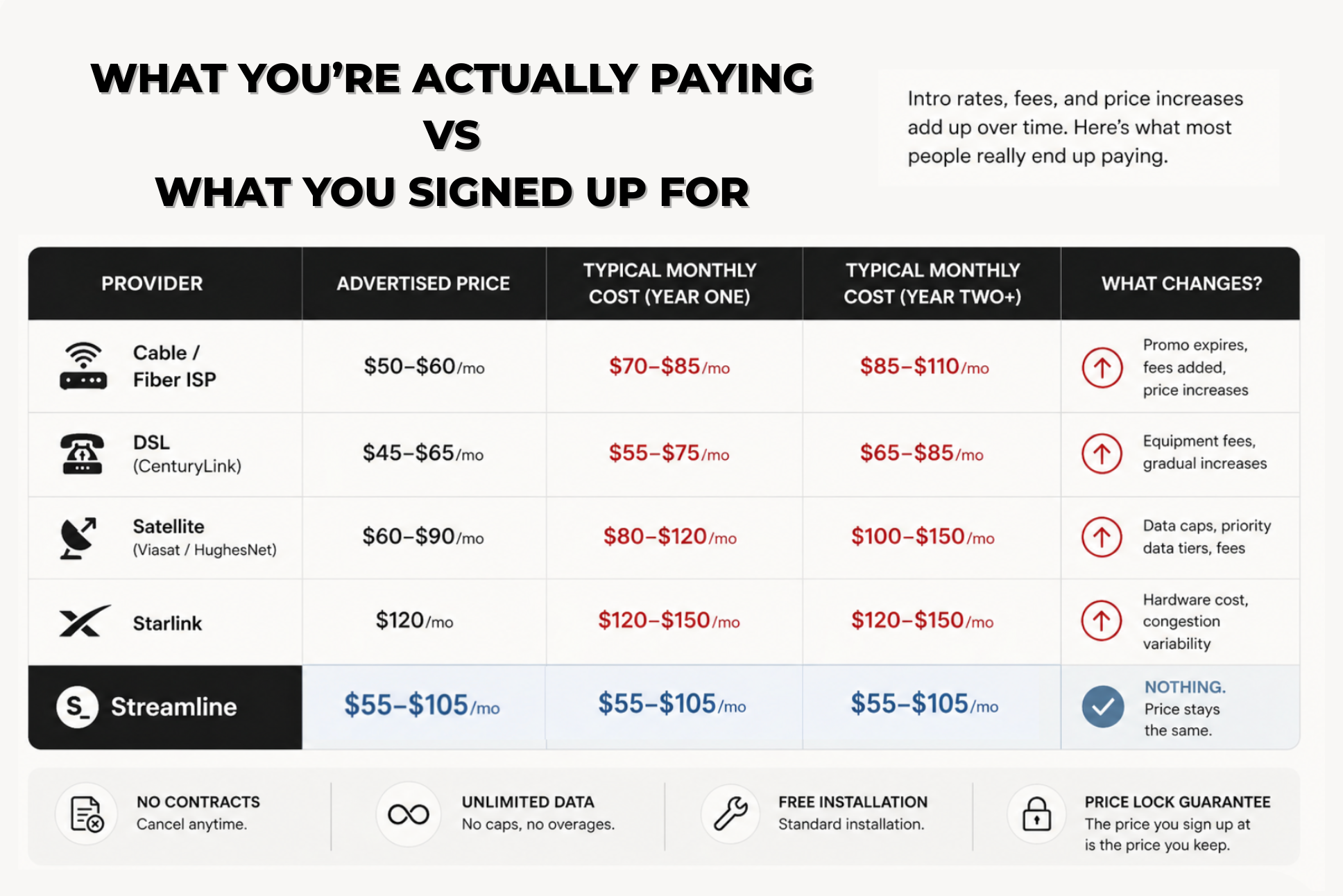
That number is there to get you connected. After that first stretch, the plan resets to a higher standard rate. It’s a noticeable jump, and it shows up without any real change to the service itself. Same speeds, same reliability — just a higher bill.
And the increases don’t stop there
Once that initial jump happens, more small adjustments start to show up over time. A few dollars added here, another change later, almost always tied to “network costs” or “general pricing updates.” Together they all move the bill in one direction: up.
Give it a couple of years and the number you started with will be a distant memory.
Your monthly total is higher than it looks
The number advertised at signup is usually just the base plan.
Costs also show up in equipment rentals. Modem and router fees get added on, along with charges tied to Wi-Fi systems or installation that’s spread out across the bill. What began as a $60 plan often lands closer to $75 or $90 once everything is included — and those line items are liable to climb as the base costs do.
Considering breaking up as an option? Think again
At a certain point, switching providers starts to feel like the obvious next move. In practice, it takes more effort than most people want to deal with.
There are lengthy contracts that keep you stuck, equipment to return, install windows to schedule, and gaps where you’re without service while everything gets set up again.
Worse still, in areas like Hendry County where options are already limited, you’re going to be struggling that much longer just to get stuck in the same cycle of being affordable one year and skyrocketing the next.
In larger cities, pricing tends to stay tighter because there are more providers competing for the same homes. Out here, the infrastructure tells a different story. Much of the network was built years ago and extended outward rather than designed specifically for the area. As more homes connect, especially during peak hours, the strain shows up in slower speeds and less consistent performance.
That means the price keeps moving while the experience stays familiar — or gets worse. Evening slowdowns, occasional drops, and the same workarounds people have been using for years.
“Available” doesn’t mean it was built for you
Most providers can say they cover your address, but that really only means the network can reach you. It doesn’t say much about how well it performs once you’re on it. Capacity, congestion, and how the network is laid out all affect the day-to-day experience — and those don’t improve just because the bill does.
If you’re already living with slow internet in Hendry County or weighing whether DSL is still fast enough, price creep is the second half of the same story.
Tired of watching your bill climb?
See if Streamline covers your address. Plans from $55/mo, locked for life.
Check availabilityWe’ve Streamline(d) a way out, custom-made for Hendry County
Some people handle this by calling in once a year and asking for a new rate. That works for a short time — but it also means repeating the same process again later.
There’s a much easier and much more affordable option: step out of that pricing model entirely and choose a plan where the number stays fixed for the rest of your life.
Sound too good to be true? Streamline was built around a different idea from the start. No contracts. No data caps. No hidden fees. Standard installation is included, and the price you sign up with is the price you keep — forever.
Plans start around $55–$60 a month, and for first responders, active-duty military, and essential workers (like teachers), your bill could be as low as $50.
But this pricing only works if the network behind it can keep up. That’s why Streamline’s fixed wireless network is local — your connection goes to a nearby tower instead of traveling long distances through shared infrastructure. Multiple data paths allow traffic to reroute when something goes down, and backup power at key sites helps keep service running during outages. Your connection stays consistent, even during the times when other networks tend to struggle.
Here’s the bottom line
If your internet bill has been climbing, it’s time to choose a provider where the price doesn’t change and the network is built to support the people using it.
Ready for a price that stays put?
Check if Streamline covers your address. Plans from $55/month, with no contracts, no caps, and no price increases.
Check availability